Showing posts with label Kareem Abdullah. Show all posts

ANWER GHANI; EXPRESSIVE NARRATIVE IN" THE SOLDIERS OF GOD" BY KAREEM ABDULLAH


Expressive narrative poetry is a literary writer which seeks to achieve poetry in the center of prose without inclination to one of them or tyranny in the text, just as poetry manifests itself, prose is also manifested. Poetry manifests itself in the expressive narration by lyric expressiveness and prose is manifested by writing free from all splitting or formal music or other visual or formal art where the coherent, continuous and logical construction of sentences and paragraphs.
Expressive narration is an attempt to answer a question about prose poetry and prose poem; what is prose poem? How can a prose verify poetry? Is what is written from prose poetry improved with visual music and what is the form that achieves the integration of prose poetry?
Expressive narration was an attempt to answer a question about poetry: What is poetry? We see the poetry remaining in the translated poetry in which there is no visual or formal music, so what is poetry and where does the poetry lie?
Expressive narration was an attempt to answer a question about the text? What is the text, is it the writing that is on the paper, or is it another presence in the level of what is behind the writing and in the mind and among the reader and between individuals?
Here, in these lines, we will clearly see the expressive narration in the “Soldiers of God” poem by the Iraqi poet Kareem Abdullah.
Karim Abdullah's poems are generally distinguished by long expressions and complete prose, with a continuous sentences structure without apparent fragmentation, but fragmentation in depth. It tells but it does not tell an event, but rather tells a feeling. With meaning that it does not tell a story, but rather tells poetry and lyricism.
THE SOLDIERS OF GOD by KAREEM ABDULLAH was translated from Arabic by me John Henry Smith.
THE SOLDIERS OF GOD
KAREEM ABDULLAH
Heavily armed with their frustration, Your soldiers drag the metropolis misery before your authority that ends up in the blindest tyranny, violate their humanity and you do not know anything about the banks of supplication lounged on by her distant voice that comes to the ears of the sea, whenever the trees of alienation smile, the extensive face of night falls, lying there, ahead the soldiers as deconstructing my lavishing history on the tongues of the ominous war. They led the leftover of dream crucified in your shining evening, searing it in front of the mockery of stations, eulogized by the childbirth of a morning that sleeps on the brink of a glow of the waiting of my return shackled with rifles as tearing the whoop of the resurrection, tattooed on the wings of the colorful butterflies behind the glass of the bombed cars.
This ten-line poem is only three sentences. This is very strange in poetry. And that the third sentence exceeds the length of the four lines.
1-      Heavily armed with their frustration, your soldiers drag the metropolis misery before your authority that ends up in the blindest tyranny, violate their humanity and you do not know anything about the banks of supplication lounged on by her distant voice that comes to the ears of the sea.
2-       Whenever the trees of alienation smile, the extensive face of night falls, lying there, ahead the soldiers as deconstructing my lavishing history on the tongues of the ominous war.
3-      They led the leftover of dream crucified in your shining evening, searing it in front of the mockery of stations, eulogized by the childbirth of a morning that sleeps on the brink of a glow of the waiting of my return shackled with rifles as tearing the whoop of the resurrection, tattooed on the wings of the colorful butterflies behind the glass of the bombed cars.


These sentences are written in a simple and very poetic prose, without fragmentation or free of logic, and in a striking scriptural style, but from this prose the poetry emerges. How Kareem did it? It's the expressionism.

The title brought the reader to a world of idealistic soldiers, but he is shocked by strong protest and words full of blindness, bitterness, and destruction.
Through this shift in the mind of the reader from the field of idealism to the field of criticism and tyranny, Kareem Abdullah achieved an important expressionism. Then, after the reader realized that Kareem Abdullah is talking about soldiers who are not from God, but they are the soldiers of the blind dictator and the tyrant at that time, the mind starts to arrange his duties, but the shock happened and went away in the depth.
Now the reading begins to notice that it is in front of a world of metaphor and symbolism, but amid the apparent structure of the story and prose, it is the art of opposites, which creates expressiveness from the story and poetry from prose. So, the prose poem comes true.
Then the reader begins with realizing that the words are not intended to be their characters and their souls, but rather their symbolism, and that the events are not intended to be their time and place, but rather the emotional strength and feelings they carry, and thus the lyricism in constructive prose is achieved.


THE SOLDIERS OF GOD BY KAREEM ABDULLAH

ARCS PROSE POETRY ANTHOLOGY 2020

THE SOLDIERS OF GOD
 KAREEM ABDULLAH
WILL BE LAUNCHED IN DECEMBER


The Soldiers of God by Kareem Abdullah

The Soldiers of God
Kareem Abdullah


A Three-dimensional Text

Heavily armed with their frustration, Your soldiers drag the metropolis misery before your authority that ends up in the blindest tyranny, violate their humanity and you do not know anything about the banks of supplication lounged on by her distant voice that comes to the ears of the sea, whenever the trees of alienation smile, the extensive face of night falls, lying there, ahead the soldiers as deconstructing my lavishing history on the tongues of the ominous war… They led the leftover of a dream crucified in your shining evening, searing it in front of the mockery of stations, elegized by the childbirth of a morning that sleeps on the brink of a glow of the waiting of my return shackled with rifles as tearing the whoop of the resurrection, tattooed on the wings of the colourful butterflies behind the glass of the bombed cars.

The Soldiers of God; a three-dimensional text  by Kareem Abdullah translated by me John Henry Smith.


Revelations that Close the Doors of Grief A prose poem by Kareem Abdullah & Rahmeh Innab

 When homeland faded away, the rivers of its dreams disappeared, the soul lamented its being rusted, the teeth of its whales whiz, distressing the beautiful dreams, it is overwhelmed by chaos, contained in the orange blooms that escape the ash of frustration, in the far, it changes the clothes of its grieves, to be a companion, it aspires for you to decode the mysteries of its laughter usurped streets, how majestic the rock of exile is! crouching to close the doors of day wishes, its ruthless grin confiscates the shine of the dawn, it is suddenly overtaken by the frost of silence, appealing for the compassionate salvation, like a butterfly breaking the dark of the cocoon, as greedy as light to hasten the secrets of emancipation, waiting for Don Quixote* to whip the horses of madness, ridding the princesses’ treasures of the grip of numerous grieves, which are by wind borne, the tenderness of fear burdens the freshness of joy, so bewitched by the isles of sapphire, goes on fighting fiercely to preserve a conviction that demolishes delusions, racing with her musically tuned pale tear, as radiating to familiarize the gloom of tablet-inscribed time, sneaking scent that saddles the pulse, slaying the dark, stricken by thickets of the spittle, we pour the epics of love wine that melts the steel of myths outside time, we are here alone, arranging lamps of the Unseen, filled with cantos of orotund unification, we melt together, despair slaps a harbinger that chants the birth of our new skies, contending the revival of the fertility seasons, Who experienced the burning of love, lightens the whirl of desert whose horses breed the neighing of whispering springs, shaking the thrones of compassion, harboring the ups and downs of my alienation, at the outskirts of the rising of joy, we tear the lust of the exiles of fog, we, hurriedly knock at the doors of miracles, soaring high, embarking on the horizon of the clove branches by the sap of the stars holiness, hovering round the rhythm of the heart, revelations that are accustomed to domes of fascinating songs, we cocoon together one womb accompanying the shadows of the sun that prepares the resurrection of the queen of the soul butterflies, at the beginning of the morning, we wash up the purity of craving of meetings, we sprinkle the pouring of embers of eagerness, a drop whose rivers run on the breasts of our dawn, her beaches dance, repaying the bills of the beauties of the past disappointment, so that we can wash up the cruelty of the present by eyes water and close the doors of grief.
Translated by me John Henry Smith
Kareem Abdullah                                                                            Rahmeh Innab
6423a-kareem2babdullah rahmeh


A DREAM OF CROOKED ODOR BY KAREEM ABDULLAH


 A DREAM OF CROOKED ODOR 
 KAREEM ABDULLAH 

I have fumbled your sweet spirit as overwhelming my lips rabbles. I breathe you as marigold that interposes my covers stained with memories which after this night, you will solely muse as a magnitude that washes my fawned colored clothes. With the wine of gypsy eyes, you ripen ardent passion.
You leak in me as Euphrates that abounds the afterbirth of this waiting as an intoxicated cascade of light penetrating my confused seasons. You flavor the arid eyes with long awaited grants of yours after old aged appeals. Your specter will remain copulating with the dreams of my night, disperse my fears, call back words and suckle my parts forgiveness and polish my crumbled mornings, so my laced canopies will pulse saying.
Welcome to you as you are kneading patience with the kohl of your beauties and planting in the chest vase your seedlings to perfume the tissues of the heart, so swallows come back to separate their dreams of my nightmares. You stamp the fluttering of your wings on my embalmed doors. O Bliss of your shadow.
I bequeathed you loaves, wet with smell of hunger snapping at me. Scoop up your bucket with the leftover of the stuttering of my scared wells, overtake the heights of the pale sadness, overtake fears, chanting you are. Come on and accumulate in my poems overflowed with your breaths. 
Blind were my wings, hardened, knowing no directions. The day I left my galaxies to fall, marginalized by the throes of labor and collapsed were the pupils of the morning eyes, chewing the nectar of your ecstasy and my rivers overflowed with losing, the hermit's corpse sprouts.


 Translated from Arabic  by John H. Smith

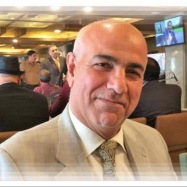
Kareem Abdullah, is an Iraqi poet and writer. He was born in Baghdad in 1962. Kareem Abdullah is the author of "Baghdad in Her New dress" ( 2015 Book House). His name had appeared in many important Arabian literary magazine and he won Tajdeed prose poetry prize in 2016 .Kareem has eight poetry collections in Arabic and his poetry was translated for many languages.

The Soldiers of God by Kareem Abdullah


The Soldiers of God
Kareem Abdullah 


Heavily armed with their frustration, Your soldiers drag the metropolis misery before your authority that ends up in the blindest tyranny. They violate their humanity and you do not know anything about the banks of supplication lounged on by her distant voice that comes to the ears of the sea.Whenever the trees of alienation smile, the extensive face of night falls, lying there, ahead the soldiers as deconstructing my lavishing history on the tongues of the ominous war.They led the leftover of dream crucified in your shining evening, searing it in front of the mockery of stations, elegized by the childbirth of a morning that sleeps on the brink of a glow of the waiting of my return shackled with rifles as tearing the whoop of the resurrection, tattooed on the wings of the colourful butterflies behind the glass of the bombed cars. 


A three-dimensional text Translated from Arabic  by me John Henry Smith


Kareem Abdullah, is an Iraqi poet and writer. He was born in Baghdad in 1962. Kareem Abdullah is the author of "Baghdad in Her New dress" ( 2015 Book House). His name had appeared in many important Arabian literary magazine and he won Tajdeed prose poetry prize in 2016 .Kareem has eight poetry collections in Arabic and his poetry was translated for many languages.


Whenever I Call You, My throat Gets Perfumed


  Kareem Abdullah


This ether bears the perfume of your images, blossoming alone in my eyes' night, raining with abundant dreams, in whose new springs swim the voices of my blooming youth. How could I collect the sprinkle of your eyes while these stars beseech for washing their darkness by the blueness of your shores. Flower coronas stand every morning at your window, waiting the moment you get up to grant them the perfume. Flocks of birds land down on your table, hoping that crumbs of your voice would make them sing very softly. Even your clothes in their cupboard are impatiently waiting your soft fingers to caress them so that they dance playfully and recover their glittering. Only your name uncovers me, since before I call you my throat gets perfumed, its strings play the symphony of this love, and all the women who went into my bosom through the hole of a needle, went out with exhalation, lamenting their bad luck. Only you swing back and forth by my veins, and so increase the pulse of my wordbooks, in order to write you an eternal poem. Oh, my fingers, whenever they touch the shyness of dew in your cheeks, it sprouts as a wail defying your crazy quake; you rain heavily on me, every night, purify me of my savagery, flap over my rivers with the wings of longing, and go deep into my cities 


Translated by Fareed Ghanem

Kareem Abdullah (b. 1962 )
Kareem Abdulah , is an Iraqi poet, born in Baghdad in  1962 . His name appeared in many important arabic literary magazine and in Tajdeed magazine, an Arabic prose poem magazine. He has many poetry collections in Arabic.